
How to organize office supplies at home starts with one honest goal, make it easy to grab what you need without turning a drawer into a junk bin. If your pens disappear, paper clips migrate, and printer paper lives wherever it fits, the problem usually isn’t “lack of organizers”, it’s that nothing has a clear home.
A good home supply system saves time, reduces duplicate purchases, and makes working from home feel less chaotic. The trick is to organize for how you actually use items, not how a catalog photo looks.
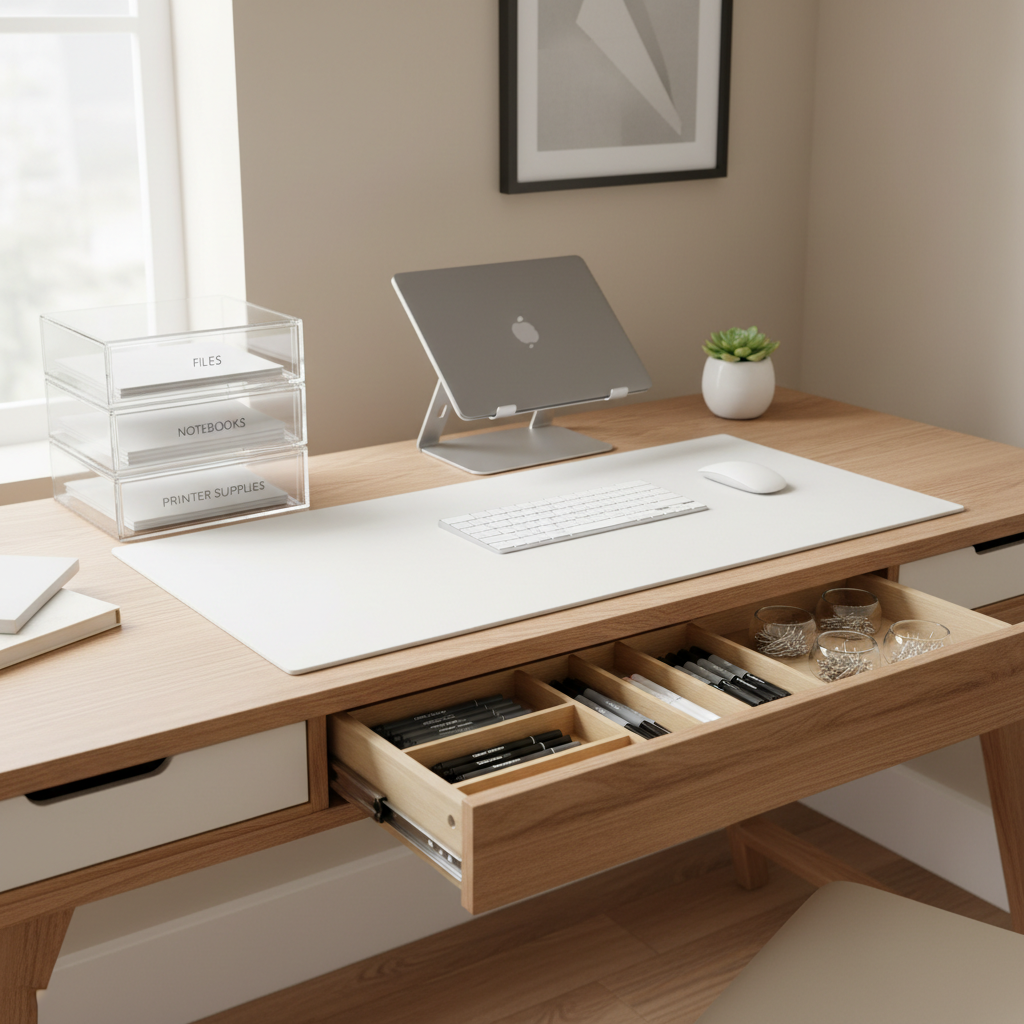
Below is a practical setup that works in many U.S. homes and apartments, even if you only have a small desk, a closet shelf, or one drawer. You’ll sort what matters, create zones, label lightly, then add a simple restock routine so the system holds.
Start with a quick reset: collect, purge, and define your “office supply” scope
Before you buy containers, bring everything into one place. Yes, it’s mildly annoying, but it prevents the classic mistake of organizing around duplicates you didn’t know you had.
Do a 15–30 minute sweep and pull supplies from the usual hiding spots: kitchen drawer, backpack, printer shelf, junk drawer, and the “temporary” pile on the floor.
- Trash/recycle: dried-out pens, broken clips, empty tape cores, outdated forms.
- Relocate: items that aren’t office supplies (batteries, random tools, old keys).
- Consolidate: partial packs of sticky notes, envelopes, labels, and pens.
- Quarantine: “maybe” items in a small box; revisit in 2 weeks.
According to EPA guidance on household waste, separating recyclables and disposing of certain items properly helps reduce contamination in recycling streams, when in doubt, check your local municipal rules for things like toner and electronics.
Choose an organizing method that fits your space (not your ideal space)
Most people organizing office supplies at home fall into one of these scenarios. Pick the one that matches your daily reality, then build around it.
1) One-drawer setup (smallest footprint)
Best if you work at a dining table or a compact desk. Your goal is a single drawer that opens to “everything I need”.
- Use a drawer divider or mix of small trays.
- Keep only daily-use tools here: pen, pencil, highlighter, sticky notes, stapler.
- Store bulk refills elsewhere (a bin, closet shelf, or cabinet).
2) Desktop caddy + one shelf (balanced)
Best if you have a dedicated desk but limited storage. A caddy handles daily tools, a shelf holds refills and rarely used items.
- Desktop: writing tools, scissors, tape, notepad.
- Shelf: printer paper, envelopes, label refills, spare pens.
3) Closet “supply station” (high capacity)
Best if your desk area must stay visually clean. Keep supplies in a closet with two or three labeled bins and a small work surface if possible.
Create simple zones: daily, weekly, and occasional use
Here’s the move that makes how to organize office supplies at home feel effortless: stop organizing by “type” only, and also organize by how often you reach for it.
- Daily zone: items you touch most workdays (pens, sticky notes, charger, stapler).
- Weekly zone: items you use a few times a month (envelopes, extra notepads, shipping labels).
- Occasional zone: specialty supplies (laminator sheets, binder clips in bulk, presentation folders).
This is also where clutter shrinks, the daily zone stays tight, so your desk doesn’t become a storage unit.
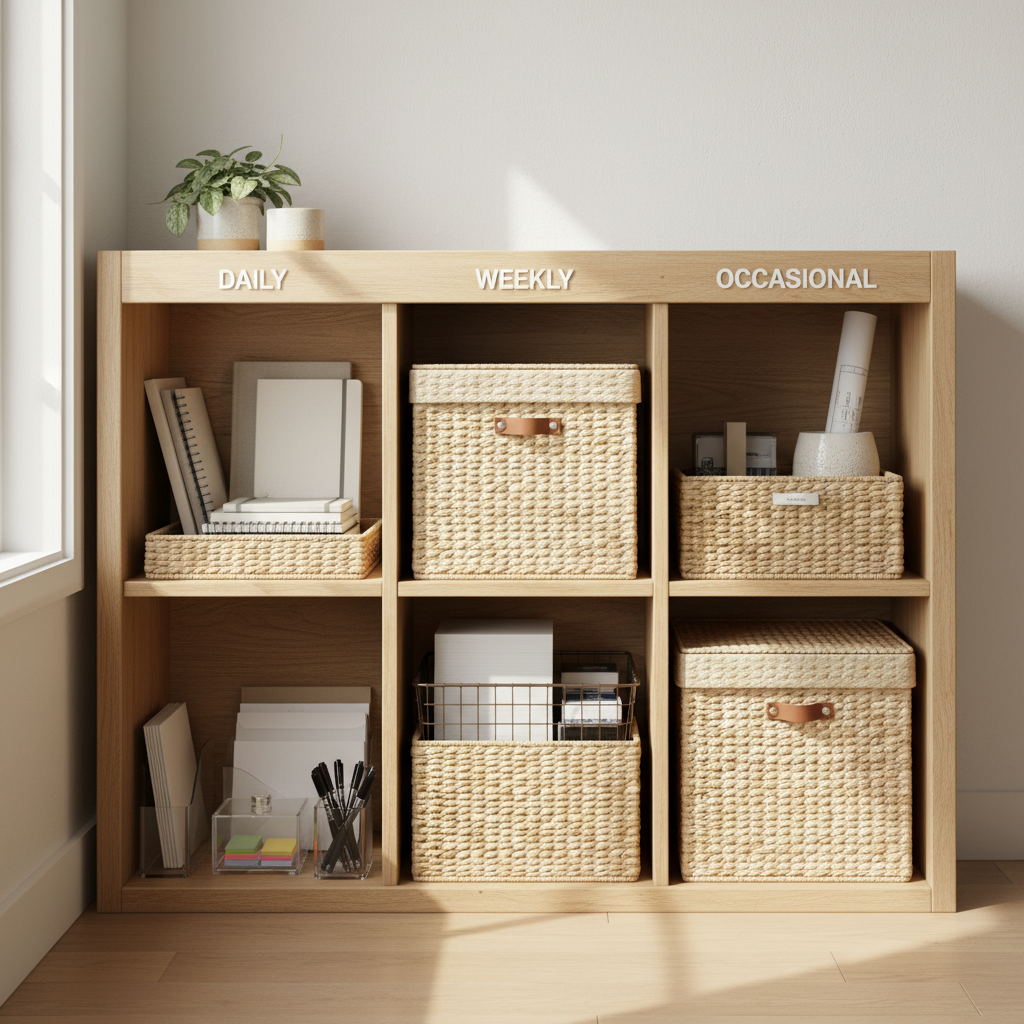
If you share supplies with kids or a partner, add one more zone: “Shared”. It prevents the slow drift of your work tools into someone else’s craft pile.
Use the right containers: fewer, stackable, and easy to rehome
Most home systems fail because containers look nice but make putting things away harder. Favor pieces that you can lift, move, and wipe clean.
- Clear bins for refills and backstock, you see what you have.
- Small trays for paper clips, binder clips, staples.
- File box for envelopes, label sheets, and small paper packs.
- One “inbox” tray for loose paper you need to process (then empty weekly).
Labeling helps, but keep it light. One label per container is enough, “Writing”, “Paper”, “Shipping”, “Tech”, not a taxonomy project.
A practical sorting guide (with a table you can copy)
If you’re stuck deciding what goes where, use this baseline. Adjust based on what you actually do at home: remote work, school paperwork, side business shipping, or all three.
| Category | What belongs here | Recommended location | Storage tip |
|---|---|---|---|
| Writing | Pens, pencils, markers, highlighters | Daily zone | Cap at 10–15 total, extras go to backstock |
| Small stuff | Paper clips, binder clips, staples, push pins | Daily or weekly zone | Use lidded mini cups or a divided tray |
| Paper | Notepads, sticky notes, printer paper, envelopes | Weekly zone | Store vertical when possible to avoid bending |
| Tools | Scissors, tape, stapler, hole punch | Daily zone | One of each, duplicates move to backstock |
| Shipping | Mailers, labels, packing tape | Weekly zone | Keep together, shipping spreads fast |
| Tech supplies | Cables, adapters, ink/toner | Occasional zone | Bag cables by device type, label the bag |
Set a restock rule so the system doesn’t collapse in 2 weeks
Organizing office supplies at home only sticks when there’s a simple rule for refills and overflow. Otherwise, you end up with half-open packs scattered across rooms again.
- One-open-pack rule: keep only one open pack of sticky notes, labels, staples, etc. Store sealed refills in backstock.
- Two-minute reset: at the end of your workday (or Sunday night), put loose items back and clear the inbox tray.
- Minimum level: choose 2–3 essentials and set a “reorder when low” point (printer paper, ink/toner, shipping labels).
According to FTC consumer guidance on online shopping, using lists and tracking purchases can reduce impulse buying, this applies to supplies too, especially when you’re restocking late at night and clicking fast.
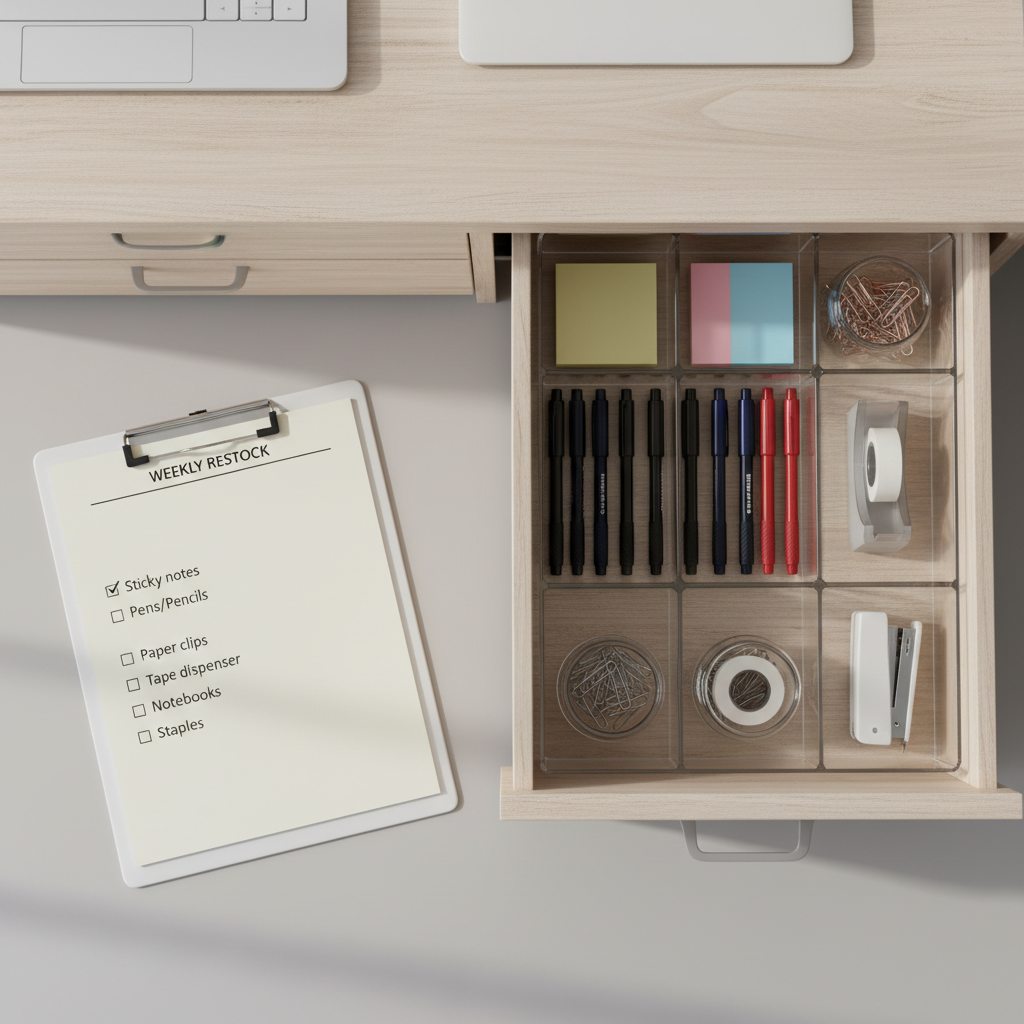
If you have kids, add one more rule that saves sanity: a small “borrow cup” for pens and scissors, anything that leaves your workspace goes there and returns in one batch.
Common mistakes that make home office supplies messy again
- Buying organizers first: containers don’t fix unclear categories, they just hide them.
- Storing by aesthetics only: if it looks great but takes effort to put away, it won’t last.
- Keeping too many “just in case” items: duplicates feel safe, but they usually create friction.
- No backstock boundary: bulk packs need one dedicated bin, otherwise they invade every drawer.
- Mixing paper with tools: paper bends, tools tangle, both become annoying to use.
Also, watch the junk-drawer effect. If one drawer becomes the “miscellaneous” zone, your brain starts using it as a shortcut for everything.
When it makes sense to get extra help (or rethink the setup)
If you’re constantly losing bills, tax documents, or medical paperwork, the issue may be less about office supplies and more about a home filing workflow. In that case, it can help to talk with a professional organizer, or at least adopt a basic document system before you keep adding containers.
If you’re disposing of ink, toner, or old batteries, rules vary by location and product, and some items count as household hazardous waste. Checking local guidance or asking a retailer about take-back programs is often the safest route.
Key takeaways (keep this part handy)
- Collect everything first, then sort, otherwise you’ll organize duplicates.
- Set up daily, weekly, occasional zones so the desk stays clear.
- Use fewer, stackable containers and label just enough to prevent guessing.
- Add a restock rule (one-open-pack + quick weekly reset) so it holds.
If you want a simple next step today, pick one drawer or one shelf and apply the zones. Once that spot feels easy to use, expand the system slowly, that’s usually how it stays organized.
Conclusion: When you treat supplies like a small inventory and give them clear homes, how to organize office supplies at home stops being a weekend project and turns into a low-maintenance habit. Choose a zone-based setup, keep backstock contained, and commit to a tiny reset routine, your future self will thank you the next time you need one specific thing fast.
Action call: Set a 20-minute timer, do the sweep, and create your daily zone today. Tomorrow, label one backstock bin and you’re already ahead of where most people get stuck.